Gemini 4 Argon Costs $2/$10. The Fine Print Says $4/$20.
Google announced Gemini 4 Argon on September 30 at an introductory $2 per million input tokens and $10 per million output tokens. Footnote one: after the introductory period, $4 and $20. Google has not said when that period ends.
Short answer: Gemini 4 Argon is Google's next frontier model, announced September 30, 2026, at an introductory $2/$10 per million tokens, with cached input 95% off. It is not broadly available yet. Access starts with trusted cyber defenders and then moves to developers. The footnote says $4/$20 applies "after the introductory period," and on our fixed chat profile that moves 1,000 messages from $29.92 to $59.84.
The launch is out of character for Google's year. The company promised a Gemini 3.5 Pro in June, spent the summer shipping smaller Flash models instead, and is only now returning to the top of its own line. It chose a crowded week to do it: OpenAI shipped GPT-6.1 Sol one day earlier at the same $2/$10 rate card and shelved its next Astra flagship over safety concerns. Google's answer costs the same, ships behind a similar gate, and carries a price-change footnote. That footnote is where the interesting math lives.
What Google actually announced
Argon is a frontier model built for long-horizon work: software engineering, legal and finance documents, cybersecurity defense. Google's numbers from the announcement: 77.9% on DeepSWE v1.1 (real-world software tasks), first place on the Vals Index (economic impact across finance, coding, legal, and tax), 91.7% on LVBench (long video understanding), 51.3% on Zapier's AutomationBench (end-to-end business workflows), and 68% on CWE-bench v1 for vulnerability remediation. Google also says Argon is its most resistant model yet to indirect prompt injection on Gray Swan's benchmark. Treat all of that as vendor-reported until independent evals show up.
The capability headline you can act on is the output ceiling: 1 million tokens in a single generation, up from 64,000 on previous Gemini models. At the announced $10 per million output rate, one response that maxes out the new ceiling costs $10 in output tokens alone. Max out the old ceiling at the same rate and it costs $0.64. If you build long agent runs, that ceiling is what you are actually buying.
The access gate is real. Argon is rolling out first to a set of trusted cyber defenders through Google's Fairwind Program. Wiz, a security vendor, says it already used the model to find a critical vulnerability in hospital software used worldwide; Google did not name the software or share details. Developers, enterprises, and consumers get access "as soon as possible," starting with paid API customers and Google AI Ultra subscribers, according to the announcement. The phased rollout is tied to the U.S. government's voluntary pre-release review process for frontier models.
What Gemini 4 Argon costs: two prices, one footnote
| Line item | Introductory | After the intro |
|---|---|---|
| Input | $2.00 / 1M tokens | $4.00 / 1M tokens |
| Cached input | $0.10 / 1M tokens | $0.20 / 1M tokens |
| Output | $10.00 / 1M tokens | $20.00 / 1M tokens |
Rates from Google's announcement, September 30, 2026. Cached input is 95% off the input rate in both periods.
As of this morning, none of this appears on Google's pricing or model pages. We searched both for "argon" and got zero rows; the only place these rates exist is the announcement and its first footnote. That matters less for shopping (you cannot buy Argon yet) and more for planning. The price is documented, not yet operational.
Now the math most coverage skipped. We price every model on the same fixed profile: 8,000 input tokens, 2,000 output tokens, 40% of the input hitting the prompt cache. That is a normal chat request in a long conversation, and it is the profile we use across these posts. At Argon's intro rates it works out to $29.92 per 1,000 messages, or just under three cents per message. After the intro, the same traffic costs $59.84.
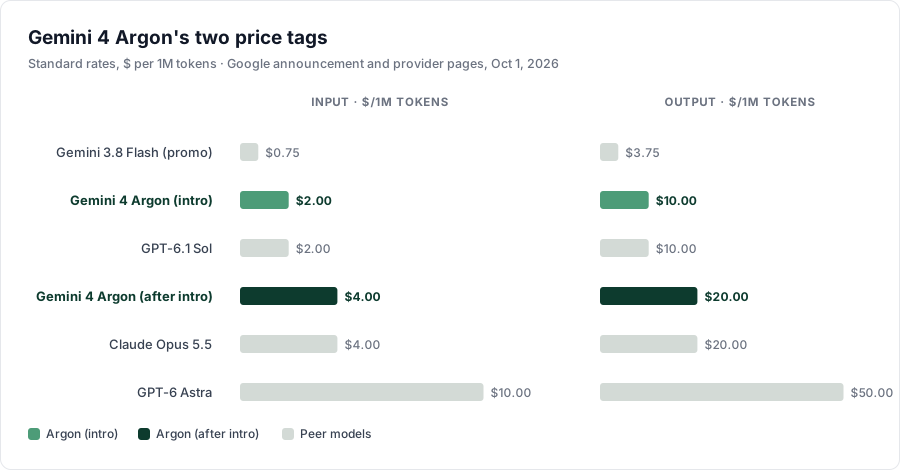
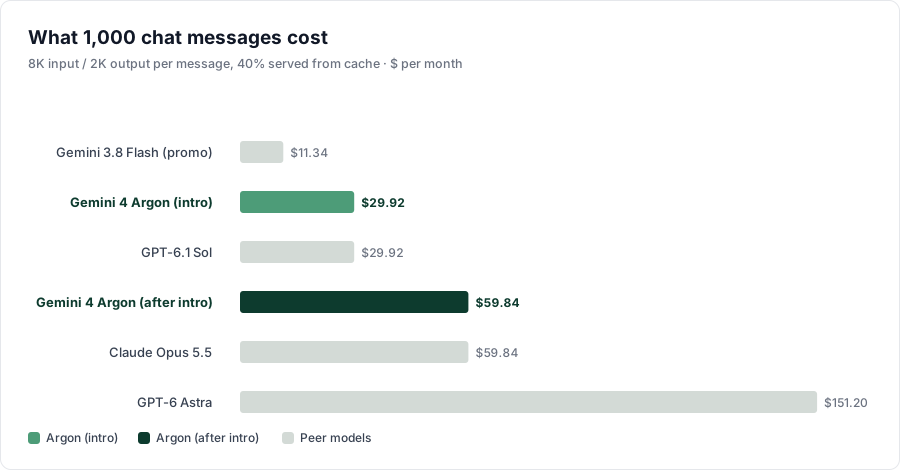
| Model | $/1M in | $/1M out | 1,000 messages |
|---|---|---|---|
| Gemini 3.8 Flash (promo) | $0.75 | $3.75 | $11.34 |
| Argon (intro) | $2.00 | $10.00 | $29.92 |
| GPT-6.1 Sol | $2.00 | $10.00 | $29.92 |
| Argon (after intro) | $4.00 | $20.00 | $59.84 |
| Claude Opus 5.5 | $4.00 | $20.00 | $59.84 |
| GPT-6 Astra | $10.00 | $50.00 | $151.20 |
The numbers above share one method: 8K in / 2K out with 40% cache reads, the same assumptions behind our estimation guide. Rebuild any row yourself: multiply input tokens by the input rate, cached tokens by the cached rate, and output tokens by the output rate.
The $2/$10 shelf
Here is the part worth a second look. Argon's introductory rate is not a new shelf: it is exactly the rate card OpenAI set 24 hours earlier, closing out a month of pricing resets.
GPT-6.1 Sol launched September 29 at $2/$10 with cached input at $0.10. Argon's intro: $2/$10, cached input $0.10. Claude Sonnet 5 has sat at $2/$10 for a while too. All three undercut the $10/$50 premium tier (GPT-6 Astra, Claude Fable 5.1, Claude Mythos 5.1) by 5x on input and output. So Argon is less "surprisingly cheap" and more "priced at the new middle on arrival." Two of the three frontier labs now advertise a $2/$10 workhorse, and the third has been there since summer.
That makes Argon look less like a price war and more like price convergence. Fine for buyers. It also makes the expiry the thing to watch: whenever the intro ends, the bill changes.
What nobody tells you about Argon's pricing
The post-intro price is not a mystery number. It lands exactly on Claude Opus 5.5's rate card, $4/$20, and on GPT-5.6 Sol's Cyber shelf, also $4/$20. So the honest way to read the announcement is: Argon will arrive at today's market rate for a frontier workhorse, and the "limited time" window is a discount off a price everyone already knows. Build your budget at $4/$20 and treat the $2 period as upside.
Second detail: the cache deal is the quiet part. Cached input at 95% off is deeper than GPT-6 Astra's 90% (its cached rate is $1.00 per million, Argon's is $0.10). It matches GPT-6.1 Sol, which also halved its cached rate this week, from $0.20 to $0.10. If you keep a 100,000-token project context warm, that costs about one cent per request on Argon or 6.1 Sol, and about ten cents on Astra. Over thousands of requests, the cache rate moves your bill more than the headline rate does.
And there are now two clocks running on Google's price list. Gemini 3.8 Flash doubles from $0.75/$3.75 to $1.50/$7.50 on January 1, 2027, a date we can circle; we walked through that promo math when the models launched in September. Argon's intro ends on a date nobody has. Flash's clock punishes waiting; Argon's rewards it. If that reads as designed to keep budgeters uncertain, well, yes.
Which should you choose? (you can't choose Argon yet)
| If you want... | Use today | Why |
|---|---|---|
| Google's best model you can actually call | Gemini 3.8 Flash | In the API now at $0.75/$3.75 through December 31; Argon is gated |
| Near-frontier quality at $2/$10 with a 1.05M context | GPT-6.1 Sol | Available now, cached input $0.10, and it is the rate Argon matches |
| The absolute frontier, cost secondary | GPT-6 Astra or Claude Opus 5.5 | The $10/$50 and $4/$20 shelves; Argon joins the $4/$20 one eventually |
| Cyber-defense work | Fairwind Program access | The first cohort is defenders; that gate is the point |
When Argon lands for paid API customers, the switch happens the way every model switch does: connect your Google key in the setup guide once, and the model becomes a dropdown choice in a workspace like this one. Until then, the correct planning number is $4/$20, not $2/$10.
What you give up (honest limits)
We cannot test Argon; nobody outside Google's first cohort can. Every benchmark here is Google's own number, run before general access, and independent scores do not exist yet. The Vals Index first place, the DeepSWE score, the prompt-injection claim: vendor-reported, dated September 30.
There is no availability date and no intro-end date. Reuters noted the model arrives "after months of delays," and Google's own wording is "rolling out soon." We priced the post-intro scenario exactly as the footnote states ($4/$20) and flagged it as the assumption it is; if Google extends the intro, everything we showed is the expensive version of events.
One more flagged guess: we assume Argon reaches the standard Gemini API rather than a separate enterprise pipeline first. The announcement says paid API customers are first in line, which implies it, but we could not verify the mechanism. If it turns out to be gated differently, the rates above still apply; only the access order changes.
FAQ
Can I use Gemini 4 Argon today? Not broadly. The first cohort is trusted cyber defenders in the Fairwind Program, and developer access follows "as soon as possible," starting with paid API customers and Google AI Ultra subscribers. If you have a Gemini API key, nothing changes yet: watch the models page for an Argon model ID.
Is the $2/$10 price permanent? No. The announcement's footnote says $4/$20 applies after the introductory period, with no end date announced. Any budget built on $2/$10 is built on a promotion.
Is Argon cheaper than Claude Opus 5.5? During the intro, roughly half price on a cached chat workload ($29.92 vs $59.84 per 1,000 messages). After it, the two share the exact same rate card, so the tiebreaker becomes quality per token, which we can't score until independent evals exist.
How much does one maximum-length Argon response cost? Up to $10 in output tokens alone during the intro, $20 after, because the model can emit 1 million tokens in one generation. Real replies are in the hundreds of tokens; the ceiling matters for long autonomous runs, which is the workload the limit was built for.
Will my existing Google key work with Argon when it ships? The access path Google described is the paid Gemini API, which is the lane a BYOK workspace already uses. When the model appears in the API's model list, a workspace wired to your Google key can route to it without new credentials.
Start your free trial → — 7 days, all providers, no credit card required.
The workspace is $2/month or $39 once — AI providers always bill your key directly at their own rates.
See pricingThe Multimodel Journal
Get the latest AI insights, model comparisons, and product updates delivered to your inbox.
Subscribe