Best AI Model for Coding 2026: The October Reprice
We ranked coding models on this page back in September: GPT-5.6 Sol vs Claude vs Gemini, benchmark-by-benchmark. Five weeks later, the price board underneath those models has been rewritten: the workhorse shelf fell from $4/$20 to $2/$10, the budget tier from $0.20/$1.20 to $0.10/$0.50, and Google's coding pick from $2/$12 to $0.75/$3.75. This refresh keeps the workload math and replaces the cast.
Short answer: For most coding work in October 2026, the value picks are GPT-6.1 Sol and Claude Sonnet 5.5 — both $2/$10, within about 1% of each other on our 200-task month ($5.98 vs $6.05). Claude Opus 5.5 ($4/$20) is the heavy agentic pick, and GPT-6 Astra and Fable 5.1 still anchor the top at $10/$50. The cheap tiers collapsed: GPT-6 Luna and DeepSeek V4.1-Flash run $0.30–$0.39 for the same month of work. Nothing on the board rose since September; the only scheduled increase is Google's, in January.
One caveat up front: this is a repricing, not a re-run of the benchmarks. Where quality claims appear, they trace to launch coverage and vendor pages, and the limits section says exactly which ones we could not verify independently. The thing we track weekly here is money, and the money moved a lot.
What changed since September
Five shifts did most of the work.
- OpenAI's workhorse shelf halved. GPT-5.6 Sol's $4/$20 (itself a promotion) gave way on September 29 to GPT-6.1 Sol at $2/$10 standard, with cached input at $0.10 per million — half of GPT-6 Sol's cached rate. OpenAI positions it as "near-Astra" intelligence at one-fifth of Astra's prices.
- The budget tier collapsed. GPT-5.6 Luna at $0.20/$1.20 became GPT-6 Luna at $0.10/$0.50. That is the same job for half the input price and less than half the output.
- Anthropic repriced from the top. Opus 5 at $5/$25 became Opus 5.5 at $4/$20. Sonnet 5.5 took over the mid-tier at exactly Sonnet 5's $2/$10 — the one rate card that did not move.
- Google swapped its coding pick. Gemini 3.1 Pro ($2/$12) no longer has a section on the pricing page; the current recommendation is Gemini 3.8 Flash at $0.75/$3.75, promotional through December 31.
- xAI and DeepSeek held. Grok 4.7 stays at $2/$6 with 500K context; DeepSeek V4.1-Flash stays at $0.15/$0.60 off-peak with a 1M context.
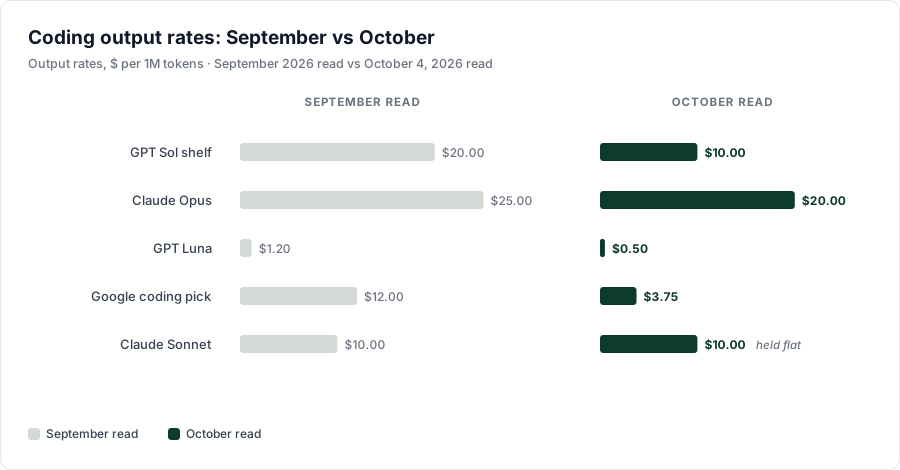
The October ladder, in one table
Standard short-context rates as of October 4, 2026, read from each provider's pricing page. Cached input is the rate that matters for coding sessions, so it gets its own column.
| Model | Input | Cached in | Output | Notes |
|---|---|---|---|---|
| GPT-6 Astra | $10.00 | $1.00 | $50.00 | The ceiling, unchanged |
| GPT-6.1 Sol | $2.00 | $0.10 | $10.00 | Current workhorse |
| GPT-6 Luna | $0.10 | $0.01 | $0.50 | Cheapest current tier |
| Claude Opus 5.5 | $4.00 | $0.20 | $20.00 | Heavy agentic pick |
| Claude Sonnet 5.5 | $2.00 | $0.20 | $10.00 | Mid-tier, flat pricing |
| Claude Haiku 4.5 | $1.00 | $0.10 | $5.00 | Fast tier |
| Claude Fable 5.1 | $10.00 | $0.25 | $50.00 | Premium tier |
| Gemini 3.8 Flash | $0.75 | $0.075 | $3.75 | Promo through Dec 31 |
| Grok 4.7 | $2.00 | — | $6.00 | No cache rate published |
| DeepSeek V4.1-Flash | $0.15 | $0.003 | $0.60 | Off-peak; 2x at peak |
Now put a real workload on it. Two hundred coding tasks a month (light for a full-time developer, a heavy month for a hobbyist) with our standard profile: 8,000 input tokens and 2,000 output tokens per task, 40% of input hitting the prompt cache. The rebuild for one row, GPT-6.1 Sol: 1.6M input tokens, 40% cached at $0.10 and the rest at $2.00, plus 400K output at $10.00. That is $5.98 for the month.
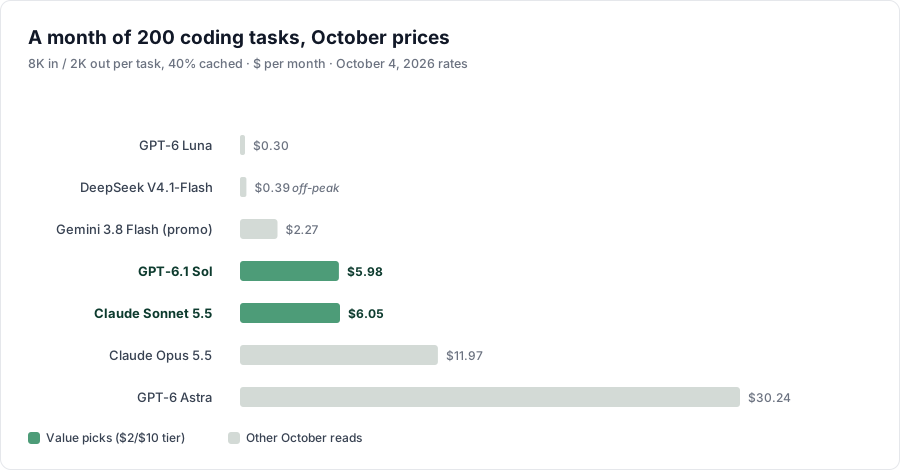
| Model | $ / 200 tasks | $ / task |
|---|---|---|
| GPT-6 Luna | $0.30 | $0.0015 |
| DeepSeek V4.1-Flash (off-peak) | $0.39 | $0.0019 |
| Gemini 3.8 Flash | $2.27 | $0.0113 |
| Claude Haiku 4.5 | $3.02 | $0.0151 |
| Grok 4.7 | $5.60 | $0.0280 |
| GPT-6.1 Sol | $5.98 | $0.0299 |
| Claude Sonnet 5.5 | $6.05 | $0.0302 |
| Claude Opus 5.5 | $11.97 | $0.0598 |
| Claude Fable 5.1 | $29.76 | $0.1488 |
| GPT-6 Astra | $30.24 | $0.1512 |
The spread: 100x between the cheapest usable tier and the frontier. For comparison, September's lineup priced the same month at $12.10 on GPT-5.6 Sol's rates, $8.00 on Gemini 3.1 Pro, and $6.05 on Sonnet 5 — so the Sol shelf halved, Google's pick fell about 70%, and the mid-tier Claude price held flat. If your coding volume has grown and your model choice has not been revisited since summer, the routing math from our cost estimation guide will now produce a very different answer.
What nobody tells you about the repricing
Cache rates are the real ladder now. Everyone compares input and output rates. In agentic coding, where you resend the same repository context dozens of times a session, the cached rate is closer to the bill. Cached input currently runs $0.01 (GPT-6 Luna), $0.075 (Gemini 3.8 Flash), $0.10 (GPT-6.1 Sol, Haiku 4.5), $0.20 (Sonnet 5.5, Opus 5.5), and $0.25 (Fable 5.1). Keep a 100,000-token context warm and resend it 50 times a day: that is $0.375 a day on Gemini 3.8 Flash, $0.50 on GPT-6.1 Sol, $1.00 on the two mid-Claudes, and $1.25 on Fable. Over a month, the cache rate alone splits the field by 3–4x before a single output token is billed.
Anthropic is the holdout. Sonnet's rate card did not fall — 5.5 launched at exactly Sonnet 5's $2/$10, and the pricing table now shows Sonnet 5's input and output cells empty. Mid-tier Claude pricing has been flat since summer while OpenAI halved the equivalent shelf. If your budget assumed everything would get cheaper, Sonnet 5.5 is where that assumption stops.
DeepSeek's cheap hours have a clock. V4.1-Flash bills $0.15/$0.60 off-peak, and peak hours are 01:00–04:00 and 06:00–10:00 UTC on weekdays — double price. Weekends are off-peak in full. A CI pipeline that runs overnight UTC pays off-peak rates; a EU-morning one does not.
Google's clock is louder. The 3.8 Flash coding rate doubles on January 1, 2027 ($0.75/$3.75 becomes $1.50/$7.50), turning a $2.27 coding month into $4.54. That is still cheap, but it is the only scheduled increase on this entire page.
Which should you choose?
| Your workload | Best fit | Why |
|---|---|---|
| Everyday coding, agent loops, mixed tasks | GPT-6.1 Sol or Sonnet 5.5 | $2/$10 each; pick by taste, the price ties |
| Long-horizon agentic sessions, big refactors | Claude Opus 5.5 | $4/$20, half the old Opus 5 rates you probably budgeted |
| High-volume routine work: tests, migrations, classification | GPT-6 Luna or DeepSeek V4.1-Flash | $0.30–$0.39 per 200 tasks |
| Front-end and web generation | Gemini 3.8 Flash | Cheapest frontier-adjacent tier — until Jan 1 |
| Maximum capability, cost secondary | GPT-6 Astra or Fable 5.1 | $10/$50; the last price point that never moved |
| Budget sessions that must survive 2027 | DeepSeek V4.1-Flash | No scheduled increase, and cache hits at $0.003 |
What we could not verify
We did not re-run benchmarks for this refresh. Terminal-Bench, SWE-bench, and arena numbers move monthly and several coding-specific leaderboards we used in September have not been re-read; treat any quality positioning above as price-and-availability inference, not fresh evals.
Sonnet 5.5's speed and cost-per-task claims ("30% faster," "up to 30% cheaper per task") come from Anthropic's launch and press coverage, not our own tests. One reviewer analysis we read argues Sonnet 5.5's top benchmark scores arrive with a larger token budget, which would eat into the per-task savings; that analysis is single-source and we could not replicate it, so we did not fold it into the math. It is the thing to watch if you route heavy Claude traffic.
Grok 4.7 shows no cached-input rate on xAI's docs, so our Grok row bills every input token at full price. If xAI adds caching, that row improves. And one flagged guess: that Anthropic's flat Sonnet pricing reflects capacity costs rather than strategy. We have no reporting on it; the rate card is the only evidence.
FAQ
Is GPT-6.1 Sol better than Claude Sonnet 5.5 for coding? They cost the same and target the same tier; OpenAI pitches Sol on agentic and terminal work, Anthropic pitches Sonnet 5.5 as its fastest near-frontier model. On our workload the monthly difference is seven cents. Test both on your hardest real task; the price gives you no reason to pick blind.
What is the cheapest coding model right now? GPT-6 Luna at $0.10/$0.50, or roughly $0.30 for 200 tasks on our profile. DeepSeek V4.1-Flash is close behind at $0.39 off-peak with a bigger context window; we covered its launch-day pricing here. Both are budget tiers: great for volume, not for nuanced refactors.
Which Claude should I use for coding now? Sonnet 5.5 for most work, Opus 5.5 when sessions run long or the codebase is large. Opus 5.5 at $4/$20 undercut Opus 5's $5/$25, so the step up from Sonnet costs less than it used to.
Did anything get more expensive since September? No. Every rate we tracked fell or held. The one increase on the calendar is Google's Gemini Flash promo ending January 1, 2027, when 3.8 Flash doubles.
Do I need to change anything in my code? Only if you pinned old model strings. GPT-5.4 Mini and Nano remain usable but are off the public price list (and Nano now carries a deprecation date of April 1, 2027); GPT-5.6-era models still work. New work should default to a current generation; the September recheck covers that migration in detail.
Start your free trial → — 7 days, all providers, no credit card required. Connect your keys once per provider (OpenAI, Anthropic, Google) and the whole table above becomes a dropdown in Multimodel Chat.
The workspace is $2/month or $39 once — AI providers always bill your key directly at their own rates.
See pricingThe Multimodel Journal
Get the latest AI insights, model comparisons, and product updates delivered to your inbox.
Subscribe